
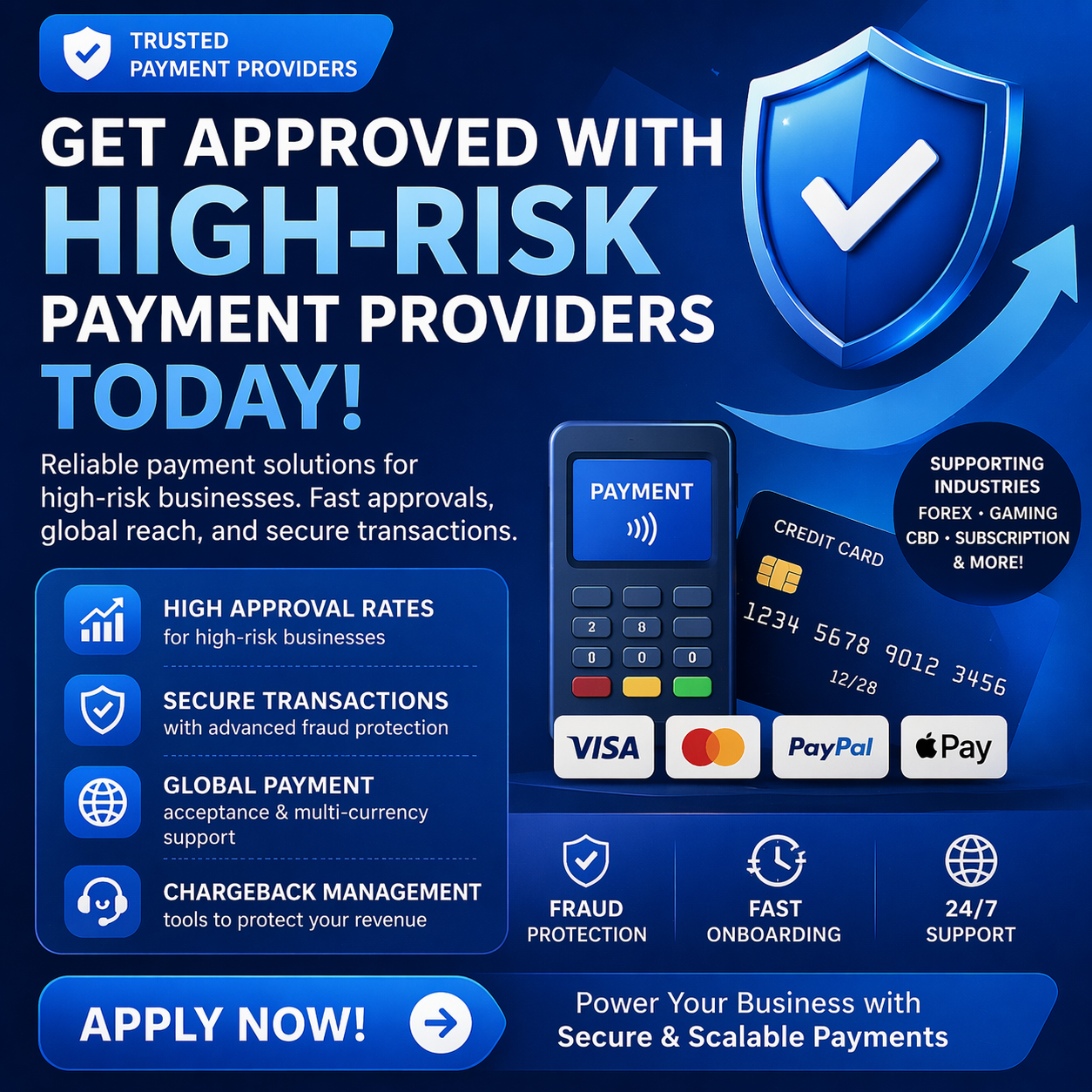
In today’s rapidly evolving digital economy, not all businesses are treated equally when it comes to payment processing. While standard eCommerce brands often enjoy seamless onboarding and low transaction fees, others—classified as high-risk merchants—face a very different reality.
From higher chargeback ratios to regulatory scrutiny, high-risk businesses often struggle to secure reliable payment processing. This is where Payment Providers play a critical role. By offering specialized infrastructure, risk management tools, and global payment capabilities, they enable high-risk businesses to operate, scale, and compete effectively.
This guide breaks down how Payment Providers support high-risk merchant accounts, what to look for when choosing one, and how businesses can make informed, confident decisions.
What Are High-Risk Merchant Accounts?
A high-risk merchant account is a type of payment processing account assigned to businesses that are more likely to experience fraud, chargebacks, or regulatory issues.
Key Characteristics
High chargeback ratios (often exceeding card network thresholds)
Industry-related risks (legal, reputational, or compliance-based)
Cross-border transactions with increased fraud exposure
Recurring billing models that may lead to disputes
Common High-Risk Industries Supported by Payment Providers
High-risk classification doesn’t necessarily reflect poor business practices—it often depends on industry dynamics.
Examples include:
iGaming and online betting platforms
Forex and cryptocurrency services
CBD, supplements, and nutraceuticals
Travel and ticketing businesses
Subscription-based services (SaaS, memberships)
For these businesses, accessing traditional payment infrastructure can be difficult—making specialized Payment Providers essential.
Why Traditional Payment Providers Avoid High-Risk Merchants
Traditional banks and standard payment processors are typically risk-averse. Their infrastructure and compliance frameworks are designed for predictable, low-risk transaction environments.
Here’s why they often decline high-risk merchants:
Chargeback Exposure: High dispute rates can result in penalties from card networks
Fraud Risk: Increased likelihood of fraudulent transactions
Compliance Burden: Complex KYC (Know Your Customer) and AML (Anti-Money Laundering) requirements
Reputational Risk: Associations with certain industries may impact brand perception
As a result, many businesses find themselves underserved—creating a gap that specialized Payment Providers are designed to fill.
How Payment Providers Support High-Risk Merchant Accounts
Specialized Payment Providers offer tailored solutions to help high-risk businesses overcome operational challenges and scale effectively.
1. Flexible Underwriting and Risk Assessment
Unlike traditional processors, high-risk Payment Providers use:
Industry-specific risk models
Customized onboarding processes
Dynamic risk scoring systems
This allows them to evaluate businesses more holistically rather than rejecting them outright.
2. Advanced Fraud Prevention Tools
Fraud is one of the biggest challenges for high-risk merchants. Leading Payment Providers offer:
AI-powered fraud detection systems
Real-time transaction monitoring
3D Secure authentication (e.g., 3DS2)
Device fingerprinting and behavioral analytics
These tools reduce fraud while maintaining a smooth checkout experience.
3. Chargeback Management Solutions
Chargebacks can severely impact profitability and processing eligibility.
Payment Providers help by offering:
Chargeback alerts and early warning systems
Automated dispute management tools
Representment support (helping recover lost revenue)
Detailed analytics to identify root causes
4. Multi-Currency and Global Payment Acceptance
High-risk businesses often operate globally.
Top Payment Providers enable:
Multi-currency processing
Local payment methods (APMs)
Cross-border transaction optimization
This ensures businesses can expand internationally without friction.
5. High Approval Rates and Processing Redundancy
To reduce downtime and failed transactions:
Providers connect merchants to multiple acquiring banks
Offer backup processing routes
Ensure higher transaction success rates
This redundancy is critical for business continuity.
Key Features to Look for in Payment Providers for High-Risk Businesses
When evaluating Payment Providers, decision-makers should prioritize features that align with both operational and growth needs.
Essential Features Checklist
✅ Multiple payment methods (cards, wallets, bank transfers, APMs)
✅ Advanced fraud and risk management tools
✅ Recurring billing and subscription support
✅ Flexible APIs and seamless integrations
✅ Real-time reporting and analytics dashboards
✅ Global coverage with local payment options
Comparing Payment Providers for High-Risk Merchant Accounts
Not all Payment Providers offer the same capabilities. A structured comparison helps businesses make better decisions.
Key Factors to Compare
Approval rates for high-risk industries
Geographic coverage (local vs global)
Supported payment methods
Integration complexity
Settlement timelines
Customer support quality
Example Comparison Table
FeatureProvider AProvider BProvider CHigh-risk industry support✔✔LimitedChargeback toolsAdvancedBasicAdvancedGlobal paymentsYesLimitedYesAPI flexibilityHighMediumHigh
💡 Tip: Use comparison platforms or directories to evaluate multiple Payment Providers side by side.
Pricing Models of Payment Providers for High-Risk Merchants
Pricing for high-risk merchant accounts differs significantly from standard payment processing.
Common Pricing Components
Transaction fees: Typically higher due to risk exposure
Rolling reserves: A percentage of revenue held as security
Setup fees: Initial onboarding costs
Monthly fees: Maintenance and service charges
Cross-border fees: Additional charges for international payments
Why Are Costs Higher?
Increased fraud and chargeback risks
Additional compliance requirements
Need for specialized infrastructure
A transparent pricing structure is essential when comparing Payment Providers.
Compliance and Regulatory Considerations
Compliance is a critical factor for high-risk merchants operating globally.
Key Regulatory Requirements
PCI DSS (Payment Card Industry Data Security Standard)
KYC (Know Your Customer) verification
AML (Anti-Money Laundering) monitoring
Regional regulations (e.g., GDPR in Europe, local financial laws in APAC and the US)
Reliable Payment Providers simplify compliance by embedding these requirements into their systems.
Benefits and Limitations of Payment Providers for High-Risk Accounts
Benefits
Access to global payment infrastructure
Higher approval rates compared to traditional processors
Scalable solutions for growing businesses
Advanced fraud and risk management tools
Limitations
Higher transaction fees
Rolling reserve requirements
Longer onboarding and underwriting timelines
Understanding both sides helps businesses set realistic expectations.
How to Choose the Right Payment Providers for Your Business
Selecting the right partner requires a structured, business-first approach.
Step-by-Step Decision Framework
Identify Your Risk Profile
Industry type
Chargeback history
Geographic exposure
Define Business Requirements
Target markets
Payment methods needed
Volume expectations
Compare Multiple Payment Providers
Features
Pricing models
Integration options
Evaluate Technical Compatibility
API documentation
Platform integrations
Developer support
Assess Compliance and Security Capabilities
Certifications
Fraud prevention tools
Review Support and Reliability
24/7 support availability
SLA commitments
💡 Businesses often benefit from using comparison platforms that aggregate and evaluate multiple Payment Providers in one place.
Real-World Use Cases of Payment Providers Supporting High-Risk Businesses
1. Subscription-Based SaaS Platform
A SaaS company with recurring billing faced high chargebacks. By integrating with specialized Payment Providers, they:
Reduced disputes with smart billing descriptors
Implemented automated retry logic
Improved revenue recovery
2. Cross-Border eCommerce Brand
A global eCommerce business selling regulated products:
Enabled local payment methods in multiple countries
Reduced payment failures
Expanded into new markets
3. Forex Trading Platform
A forex platform required:
Multi-currency processing
Strict compliance tools
High transaction approval rates
Specialized Payment Providers helped them scale internationally while maintaining compliance.
Future Trends in Payment Providers for High-Risk Merchants
The landscape is evolving rapidly, with innovation shaping how Payment Providers operate.
Emerging Trends
AI-driven risk scoring for smarter fraud detection
Embedded finance within platforms
Real-time payments (RTP) for faster settlements
Expansion of alternative payment methods (APMs)
Improved global compliance automation
These trends will further improve accessibility and efficiency for high-risk businesses.
Conclusion: Making Confident Decisions with Payment Providers
High-risk businesses operate in complex environments—but that doesn’t mean they have to compromise on payment performance.
The right Payment Providers can:
Enable global growth
Improve transaction success rates
Strengthen fraud prevention
Simplify compliance
However, choosing the right provider requires careful evaluation of features, pricing, risk tolerance, and scalability.
By taking a comparison-driven, informed approach, businesses can identify solutions that align with their unique needs—turning payment processing from a challenge into a competitive advantage.
Final Insight
In a fragmented and often confusing payments ecosystem, platforms that connect businesses with the right Payment Providers play a crucial role—helping decision-makers move forward with clarity, confidence, and control.


Write a comment ...